

Key Points:
- Transforming education through AI-powered adaptive learning.
- Enhancing engagement with immersive AR and VR tools.
- Revolutionizing access via cloud-based learning platforms.
- Fostering collaboration through interactive digital tools.
What if the classroom of the future wasn’t confined to four walls, and learning wasn’t limited to textbooks? Imagine a world where artificial intelligence tailors lessons to each student’s pace, virtual reality brings history to life, and immersive technology turns abstract concepts into tangible experiences. The possibilities are endless, and the best part? These aren’t just dreams—they’re the emerging learning technologies that are transforming education right now. From personalized learning experiences to interactive tools that engage students like never before, how are these technologies reshaping the way we teach, learn, and connect? The future of education is here, and it’s more exciting than ever.
What are Emerging Technologies?
Technological innovations refer to technologies that are, at the moment, still in the developmental stage or are expected to be developed within the next few years. These are the emerging learning technologies that can reshape industries and open new possibilities. Well, they are in a sense enablers that still have not grown up to their full potential – nevertheless, technologies that can redefine almost every aspect of human life.
Key Examples of Emerging Technologies Across Various Industries
Artificial Intelligence (AI) & Machine Learning (ML): AI as an approach therefore is not new in the market but its functionalities are improving every day. Cutting across the transport sector and e-commerce, AI is taking over interfaces to devices and vehicles.
Blockchain: Though blockchain originally pertained exclusively to virtual currencies, nowadays, this technology is being used in such spheres as healthcare, finances, and supply chain, primarily because of its security and openness.
5G Connectivity: They say that faster internet connection is supporting innovations such as telesurgery, superior telecommunications, and enhanced real-time data analysis.
Virtual Reality (VR) & Augmented Reality (AR): These technologies are revolutionizing sectors including entertainment, and education allowing for new possibilities in audience interaction and knowledge acquisition.
Robotics and Automation: Here’s how organizations are employing the power of automation in repetitive work and moving people to higher-value tasks across manufacturing, logistics, and even customer services.
Internet of Things (IoT): Various gadgets connected to the internet are enhancing home appliances, Industrial machines, and various other machines to make them Intelligent and efficient.
Why Do These Emerging Learning Technologies Matter?
Enhancing Efficiency:
Consider how many times more efficiently something can be done with the help of automation or what is possible with the help of high-speed Internet. Incoming technologies in most cases help to optimize certain activities through increasing the productivity and efficiency of the businesses.
Personalizing Experiences:
These technologies can pinpoint user needs more accurately in emerging technologies in education through adaptation, and in e-commerce through customized shopping experiences, which makes the interaction for the better good for the user.
Driving Innovation:
New technologies are a completely new set of opportunities for thinking and approaching a specific task. They challenge a given sector and generate new approaches to solve existing issues. The things hitherto considered as things that cannot happen now become possible.

The Role of Technology in Key Sectors:
Each sector is being reshaped by emerging learning technologies in unique ways. Let’s take a look at how these innovations are driving change.
1. Emerging technologies in education
Transforming Learning Methods: Technologies such as AI platforms, learning with Virtual Reality and Augmented Reality are enhancing the processes of education making them more vivid, interesting, and individualized. Think of a learning environment in which learners can learn in 360-degree augmented reality, augmented reality videos, or a class where the learners can practice in front of an artificial intelligence teacher who can give them feedback in real-time. Technology is not only assisting learning to be easier but also enabling learning to be more engaging.
Breaking Barriers: Platforms such as the LMS enable the delivery of learning to anyone at any time regardless of location. Technology again and again is common; pulling down the geographic, as well as the financial, walls that once denied education to so many people participating in remote learning or online courses.
Better Student Outcomes: Data analytics enable instructors to monitor progress in near real-time which allows early detection of learners who require some form of support. This leads to better returns as the students gain better performance and ratings.
2. Emerging technology consulting
Improving Business Decision-Making: Consultants are turning to data, analytics, artificial intelligence, and robotics to assist companies improve their operations and market position. Namely, the above tools help achieve better analysis, higher speed of data processing, and more accurate forecasting in providing consultants with even better solutions to clients.
Driving Efficiency for Clients: all technologies in business facilitate quick and efficient running of the enterprise, cutting costs and enhancing the customer experience. For instance, cloud solutions IoT in supply chains, and AI to automatize numerous processes, and create opportunities for higher-level work.
Enabling Innovation: Outsourcing companies located in the Industry are also focusing on helping organizations use new technologies to enhance innovation. This could include issues such as blockchain for increased security, artificial intelligence for market forecasting, or smart solutions for businesses’ forward planning.
3. Emerging technologies building Sector
Smart Buildings and Homes: IoT is creating added value and a new reality in buildings as they become smarter, more sustainable, and safer. Smart homes refer to housing technologies that range from smart thermostats to the systems of automatic lighting and security, which make buildings more functional and sustainable.
Robotics and Automation in Construction: From aerial mapping to bricklaying and even building construction, robotics and drones are increasingly being used at sites. This is cultivating speed in construction, minimizing human interference, and cutting costs.
Sustainability through Technology: It is worth noting that sustainability issues are a major concern to the construction industry. Many environmentally responsible technologies such as; renewable energy systems for structures, energy-savvy materials, and environmentally conscious methods of construction are being implemented to decrease the negative impacts of construction projects.
Emerging Learning Technologies in Education
The world of education is changing fast, and technology is leading the way. New tools and innovations are making learning more engaging, personalized, and efficient. Let’s dive into some of the most exciting advancements in this space.
AI and Adaptive Learning Platforms
What is Adaptive Learning? Consider a learning environment where all the learners can get individual attention when they want and at the same time they want it. That’s what such AI-driven adaptive learning platforms are designed to achieve. These systems keep track of a student’s performance, and they provide lessons that will best fit the student’s ability and target the areas the student has proven to be weak.
Why Does This Matter? Standard-styled, classrooms do not allow the flexibility of addressing each child’s differences. That means students who require some sort of assistance can receive it and those who require a quicker pace, which most students do, can receive it. It’s very much like when you’re in school and watching your teacher adapt to different learners to come up with ways that he or she can teach all the students in the class; that is the true meaning of personalized learning we have never witnessed in our entire life. It’s not just for primary and secondary education either – universities, colleges, and adult learning programs all use these tools to ensure that learning is meaningful for all learners.
Real-World Impact: Those schools and universities that have incorporated adaptive learning applications, note the increased value, as students progressively pay more and stay longer. It’s a means of avoiding repetition whereby a teacher can easily find a student who requires extra attention on a certain topic.
Virtual and Augmented Reality (VR/AR) in Education
What Makes VR/AR Special in Learning? Picture this: Instead of reading about ancient Or being in a biology class where you are capable of experiencing and handling a 3D inside of a human body. That is the beauty of using VR and AR, especially in learning institutions- they offer practical ways of learning that make what is being taught come alive.
Engagement Through Experience: By studying VR and AR, students can feel content, which is an emotional connection that pure text knowledge cannot give. In my perspective knowledge through this kind of learning is not only enjoyable, but also such knowledge is well engraved in one’s memory. It engages curiosity and pushes people into actively participating thus transforming a passive mode of use into an engaging one.
The Future of Classrooms: This is because, as the price to the consumer of the technology decreases, the number of schools that use these technologies is likely to increase. This isn’t about cool emerging learning technologies, it is about developing learning spaces that can engage students and improve learning. Civilizations, you’re walking through a virtual version of Rome, experiencing history first-hand.
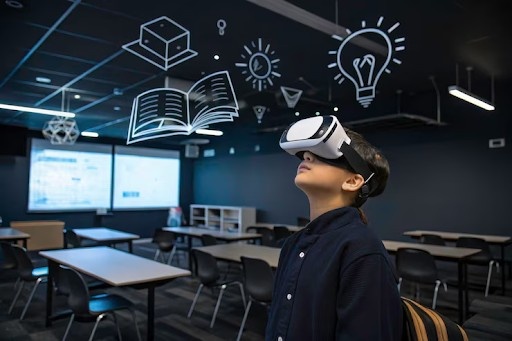
New Technology Equipment for Education and Building Sectors
Smart Classroom Tools
What Are Smart Classroom Tools? Specifically, we consider innovative tools such as interactive whiteboards, projector equipment, and Internet of Things technologies as responsive factors, disrupting the classical format of a class. These smart tools are supposed to help teachers with their work, providing more interactions, easier usage, and application.
How Do They Work? Imagine a classroom where the teacher can interact with students’ devices at the click of a button, the ability to display 3D models on the interactive whiteboard, or monitor student’s progress in real-time. Using these tools enables the teacher to display various media, models, and even live data in the lessons to make the learning process more engaging for students.
Who’s Leading the Charge? Prometheus and SMART Technologies are just a small section of technology leaders innovating in the educational space. Some of their interactive touch displays and learning solutions are being used in schools as part of the trend to building new Schools that are Internet Based. All the tools presented are not just practical but enhance the flexibility of teaching activities.
Construction and Building Equipment:
Smart Homes and Automated Construction Similar to how we now enhance learning facilities through teaching emerging learning technologies, buildings are also becoming smart. Smart homes introduced people to the idea of being able to turn on the heat, change the lights, or set the alarm through an app or conversation. But the construction industry is now catching up with the innovation as well. The use of robotics, BIM, 3D printing technologies, and mapping moves construction forward at a much faster rate than it used to be and also greatly minimizes human error.
Why Does This Matter?
This means that, with smart homes, we are not simply making things easier for us. These technologies also assist in improving energy efficiency levels as well as offering improved sustainability levels.
What Does the Future Hold?
We are starting to witness the first objects constructed using 3D printing and drones, the latter of which aid in project observation. Most of them will become mainstream in the next few years, thus rapidly altering the paradigms of construction and habitation. AI solutions will make architecture and engineering work smarter by creating effective innovations in constructing structures that are environmentally sustainable in the processes of urbanization and global warming.
Sustainable Solutions for a Better Tomorrow:
There are trends to make construction more environmentally friendly. From the construction of energy-efficient and low-emission buildings to the common use of sustainable building materials, green is the future of construction. Solar power solutions like solar panels, water harvesting solutions, and even green terceira for roofs are increasingly showing up in recent designs. To my understanding, as the world transforms into an environmentally conscious society, these smart solutions are going to be key drivers to the new forthcoming cities.
FAQs
What are emerging learning technologies?
Emerging learning technologies are innovative tools, platforms, or methods that leverage advanced technology to enhance education and learning experiences. Examples include AI-based tutors, virtual reality classrooms, and adaptive learning software.
Why are emerging learning technologies important?
These technologies help personalize education, increase engagement, and make learning more accessible. They prepare learners for future challenges by incorporating digital tools into education.
What are some examples of emerging learning technologies?
Examples include artificial intelligence (AI) in education, virtual reality (VR), augmented reality (AR), gamification platforms, and blockchain for credentialing and assessment.
Conclusion:
Emerging learning technologies, AI, VR/AR, and smart classroom tools are creating personalized and engaging learning experiences. Consulting is being transformed by data analytics, automation, and cloud solutions that help businesses stay competitive and efficient. In construction, smart homes, sustainable practices, and automated tools like 3D printing are revolutionizing how we build for a better future.
To thrive in this evolving landscape, industries must embrace innovation and act now. Educators should integrate adaptive learning and immersive tools into classrooms, while consultants and businesses leverage AI and data-driven strategies. Construction companies need to adopt sustainable technologies and automation to meet modern demands. Continuous learning and adaptability are the keys to staying ahead in a rapidly changing, tech-driven world.